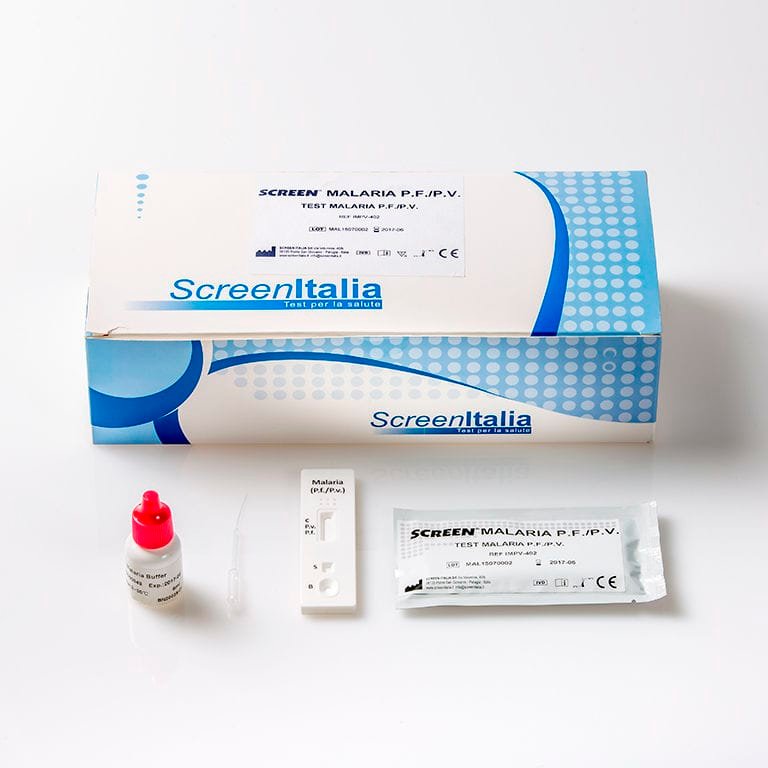
Rapid malaria test SC-0661-25
The Malaria P.f./P.v. (Whole Blood) is a rapid chromatographic immunoassay for the qualitative identification of two types of Plasmodium circulating in whole blood: falciparum (P.f.) and vivax (P.v.). The Malaria P.f
Overview
The Malaria P.f./P.v. (Whole Blood) is a rapid chromatographic immunoassay for the qualitative identification of two types of Plasmodium circulating in whole blood: falciparum (P.f.) and vivax (P.v.).
The Malaria P.f./P.v. (Whole Blood) is a qualitative, membrane-based immunoassay for the detection of P.f. and P.v. in whole blood.
The membrane is pre-coated with anti-HRP-II and anti-pLDH antibodies. During testing, the whole blood sample reacts with the colored conjugate with which the test media was pre-coated. The compound then migrates upward on the membrane by capillary action and reacts with anti-Histidine Rich Protein II (HRP-II) antibodies on the membrane in the test line area P.f. and with anti-pLDH antibodies in the P.v test line region.
If the sample contains Plasmodium-specific HRP-II or P. vivaxLDH or both, a colored line appears in the P-f- or P.v test line region. or both.
The absence of colored lines in the P.f. o P.v. indicates that the sample does not contain HRP-II and / or Plasmodium-specific P.vivaxLDH.
Malaria is caused by a protozoan that infects the red blood cells of the human blood. Malaria is one of the most widespread diseases in the world. According to the WHO, the worldwide incidence of the disease is estimated at around 300-500 million cases and over 1 million deaths per year.
Most of these victims are infants and young children. Over half of the world’s population lives in malarial areas. Microscopic analysis of an adequate thin and thick blood smear has been the standard diagnostic technique used for over a century to identify malaria infections


